






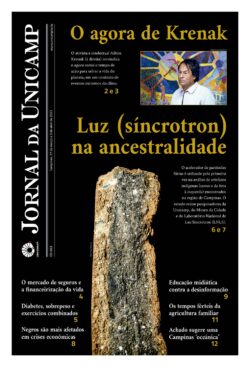
Study proves the existence of rocks at the bottom of the ocean formed more than 600 million years ago in the city

A bike ride through the Monsenhor Emílio José Salim Ecological Park, in Campinas, led professor Wagner Amaral, from the Department of Geology and Natural Resources at the Geosciences Institute (IG) at Unicamp, to make an important discovery about the city's geology. He proved, through petrographic and geochemical analyses, the existence of ocean-bottom rocks in an outcrop present in the park. The formation may be associated with the evolution of the supercontinent Gondwana.
The teacher says that, in the region of Campinas where the Park is located, there are many rock outcrops that had not been previously described. Amaral is the creator of the Geobike Extension Project, in which he travels by bicycle, with undergraduate and postgraduate students, as well as people from outside Unicamp, trails in places that are not possible to reach by car or bus. In 2020, he identified, in Ecológico, mafic (dark) rocks with “chickenpox”-shaped spots that pointed to the presence of the mineral garnet; This caught his attention. As he teaches a discipline that researches this type of rock, there is nothing more natural than studying them.
Based on analyzes carried out using the IG's scanning electron microscope, Wagner Amaral identified the chemical composition of the mineral and the textures present in the rock samples. “The microscope revealed features that are evidence that these rocks reached a very high metamorphic degree, typical of subduction zones, when two tectonic plates begin to slide under each other.”
“In the case of Campinas, the rocks on the ocean floor descended beneath another crust, to a depth of more than 45 km, were metamorphosed under high pressure conditions and, subsequently, exhumed by geological processes that allowed them to be found on the surface” , explains the teacher. This metamorphism was also dated at the IG's Isotopic Geology Laboratory (Lagis), based on geochronological analysis of a mineral called rutile, which established the age at approximately 626 million years.
Similar processes are found in the formation of modern subduction zones, such as in the Andes, which is formed by the downward movement of Pacific oceanic crust, which pushes the crust beneath the continent, raising the mountain range. In the Alps, the same thing happens: Africa is going against Europe, lifting the old continent.
Calculations of temperature and pressure conditions indicate that the rocks found reached temperatures close to 740°C and pressures greater than 12 kbar. “Upon returning to the surface and going through a decompression process, the rocks acquired textures like symplectites, a kind of intergrowth of two or more mineral phases in disequilibrium. Thus, the rock remained, for millions of years, facing other tectonic movements, deformations, glaciations and erosion. These phenomena caused the rock to weather, leaving it exposed in the form of an outcrop”, explains Amaral. There is, therefore, evidence that Campinas is in a region where, millions of years ago, there was probably an ocean.
The geological history of the planet shows us the formation of several supercontinents and oceans in cycles of approximately 450 million years – the so-called Wilson Cycle. 1 billion years ago, there was a supercontinent called Rodinia, which fragmented, generating other smaller continents and oceans. The rocks identified in the Ecological Park may be associated with the evolution and closure of another supercontinent, Gondwana, which occurred between 600 and 500 million years ago, in the southern hemisphere of the globe, due to the collision of the continental fragments of Rodinia. “About 250 million years ago, the supercontinent Gondwana coalesced with other scattered continents in the northern hemisphere, known as Laurasia, to form Pangea. Today, we are the product of the breakup of this last supercontinent, which remained united for just 50 million years. As a consequence, we have the current oceans that are still developing”, explains the professor.

Amaral's discovery is consistent with similar geological situations found in the south of Minas Gerais, in the regions of São Sebastião do Paraíso, Varginha and Pouso Alegre, which also have rocks with a similar age, chemical composition and geological context to those found in Campinas. “Our municipality has great geological potential. The city is bisected by two strike-slip shear zones and is situated within four distinct geological domains. We are advancing our understanding of the geological history of our region with more detailed geological mapping and more refined analytical techniques. The characterization of these rocks found in the Ecological Park reinforces the hypothesis of the existence of an ancient subduction zone that passes through Campinas and beyond”, points out the professor.
According to Amaral, there are two articles in preparation. In his undergraduate thesis, Lucas Prado Bertini Oliveira, a master's student at IG, carried out a geological mapping of the region where these rocks occur. “The mapping also revealed to us the presence of several other outcrops with similar characteristics, fundamental for understanding how the bodies were arranged, which rocks were associated, in addition to the dimensions and structural deformations that were present. We identified outcrops, measuring around 500 m2, of this rock”, explains the professor. Now, Oliveira has been deepening analytical studies on the metamorphic rocks of this region. “Another master's student, Marcos Zacarias Farhat Junior, is cataloging geoscientific points of interest so that his work becomes a scientific dissemination tool”, concludes the professor.