

In recent weeks, likely spurred by readings, discussions, and conversations with students and young scientists, a question has been on my mind: is academia an attractive career in Brazil? Before delving into the search for this answer, I propose we look at some data.
When we think about the challenges facing Brazilian science, we often talk about funding, infrastructure, equipment, or scholarships. But who will do science in the future? No scientific system exists without people willing to dedicate a significant part of their lives to the production of knowledge. While laboratories can be built, equipment can be purchased, and calls for proposals can be launched, scientists, on the other hand, need to be trained. And they need to want to be scientists.
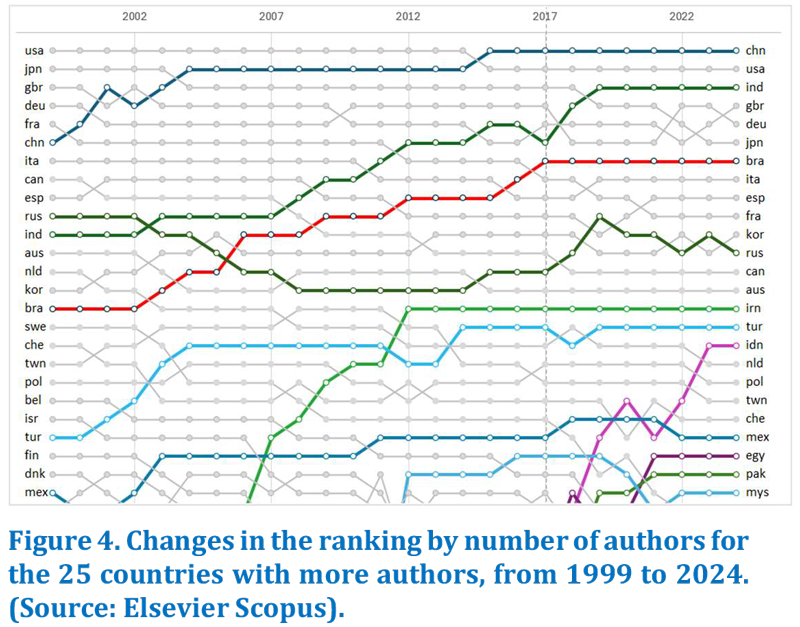
This is a relevant issue. Data compiled by UNESCO in 2023 shows that, on average, there are 1.486 scientists per million inhabitants in the world (working full-time). The latest data collected in Brazil in this regard was in 2013, when we had 903 scientists per million inhabitants. Given the considerable growth in the number of PhD holders in the last decade, it is possible to estimate that Brazil should now have a scientific community closer to the world average. Even if only approximately, there is a significant gap between Brazil and the nations that concentrate a large part of the world's knowledge production.

The number of scientists per million inhabitants in the USA, Germany, Denmark and South Korea is 4.937, 5.926, 8.838 and 9.472 respectively, with the latter being more than six times the world average. Closer to our reality, available data from Argentina shows 1.313 scientists per million inhabitants; in some of the BRICS countries, Russia and China were positioned in 2023 with 2.653 and 2.107 respectively, with the Chinese figure likely having increased significantly in the last three years. China, whose population is almost seven times larger than Brazil's, already had 50% more scientists per million inhabitants than our country [1].
If we want to have a scientific community that is more representative in terms of population, we need to expand that community. And let's acknowledge: Brazil has built a postgraduate system in recent decades capable of training thousands of highly qualified researchers. In 2024, 25.915 new PhDs were awarded in the country. This is an extraordinary achievement considering that, in 1998, that number was 3.915 per year. [2] Having done that, it is now necessary for these people to see science as a concrete possibility for the future.
It is inevitable to consider that, to make a scientific career attractive, we need consistent investment, as already argued in this column on April 22, 2026. In 2023, Brazil allocated approximately 1,19% of its GDP to research and development. In that same year, China allocated 2,58%, Germany 3,13%, and the United States 3,42%. However, it is very important to note that, in countries with more robust scientific systems, a significant portion of this effort comes from companies. The business sector accounted for approximately 2,14% of R&D investment in Germany and 2,66% in the United States, while in Brazil this investment was 0,62% [ 3 , 4 ]. This difference helps explain why, in many economies, a scientific career is not restricted to universities and government research institutes. Research is also conducted in companies across different economic sectors, while in Brazil it remains much more concentrated in universities and public institutions. It is therefore not just a matter of training more scientists, but of building an economy capable of absorbing and valuing this knowledge.
Having presented all this data, I would like to return to my initial question: is academia an attractive career in Brazil today? Let's begin by considering that an academic career hasn't ceased to be good. On the contrary, few professions offer a combination of intellectual autonomy and the potential for a lasting legacy, given the possibility of discovering something unknown and shaping new generations of thinking minds. Being a scientist is intellectually stimulating. But I think the problem lies elsewhere, such as in the necessary path to reach this career and how it is perceived by society.
From a labor perspective, an academic career is long and forged on periods of instability regarding social security (fortunately changing) and benefits. After graduation, there is usually a master's degree and necessarily a doctorate, which are often followed by years of postdoctoral work. Professional consolidation depends on obtaining scholarships, projects, and competitions. And all these opportunities are not always predictable, in addition to suffering from the inherent fluctuations of the Brazilian science funding system.
For years, a highly qualified professional may not know exactly where they will work or whether they will be able to continue doing research. This matters because academia competes, at a disadvantage, with all the other professional opportunities offered to a worker with this profile. This creates a restricted scientific job market, making "pursuing an academic career" synonymous with becoming a university professor.
This situation is different in countries where science is a matter of state policy, since research is not an activity restricted to universities. Different sectors of the economy employ scientists on a considerable scale, making the scientific job market broader and more attractive, including for Brazilians. Therefore, a society that wants to have more scientists to develop further needs to offer more job opportunities to scientists.
Beyond the issues associated with the opportunities themselves, there is the dimension of social recognition of science and, consequently, of those who produce it. A survey conducted in 2024 by the National Institute of Science and Technology dedicated to scientific communication (INCT-CPCT), with 2.276 young Brazilians between 15 and 24 years old, found a quite revealing result. About two-thirds consider that being a scientist can provide personal satisfaction. However, 55% believe that scientists have little or no prestige in Brazil [5] . Note the contradiction: while science is seen as an activity capable of providing fulfillment, the profession does not occupy a prominent place in the imagination of young people. Even so, scientists enjoy a high degree of trust. In an international survey conducted by Ipsos in 2024, 52% of Brazilians said they trust scientists, placing them among the most trusted professions in the country [6].
As also discussed in this column, science is not a state policy in Brazil. It receives investments and advances, but suffers cuts and regresses. Priorities surrounding science change according to different governments and circumstances. This instability, along with the lack of science-focused early childhood education, shapes how society perceives scientific activity. In Brazil, it is not perceived as a permanent need, as a perennial component of the country's project. Therefore, it will not be defended as essential. A society that does not recognize science as a structural part of its future will have more difficulty understanding why it needs to train and retain scientists. And, without this recognition, it will be more difficult to create a culture in which a young person considers thinking: "I want to be a scientist."
But what are the ways to shape these paths and make academic careers attractive to young minds in Brazil? While we already know how to train scientists, it is necessary to build opportunities for more predictable career paths after graduation, both for work in universities and government research institutes, as well as in the private sector. And here I am not only considering large international corporations, but also the development of national technology-based companies, especially those associated with strategic issues for the country. To achieve this, we need to increase the social value of science, because consequently, those who produce it will be valued.
Starting with the appreciation, let us consider that “talking about science” is essential! But not only in obvious moments, such as when an epidemic emerges, a vaccine is developed, or a discovery makes headlines. Scientists need to be recognizable figures in the daily life of a country that intends to be sovereign in knowledge and technology. In this sense, one can take as an example China, which recently began to display its scientists on billboards in cities [7].
In parallel, we must expand support mechanisms that make the path between training and consolidation of scientists less precarious. In São Paulo, for example, Fapesp has launched programs, such as the Generation Project and the already traditional Young Researcher, which go beyond the post-doctorate, recognizing that training scientists is different from building a scientific career [8] . It is a great move, without a doubt, but it is also essential, as mentioned above, to promote and expand science beyond the University.
Encouraging the emergence of new Brazilian technology-based companies leads to job creation, knowledge generation, and therefore financial returns, in addition to allowing the country to address important issues. Such initiatives have the potential to expand the opportunities for scientists beyond the traditional academic environment of universities. And this is not a bad thing; on the contrary, preserving intellectual and scientific freedom within the university is strategic and essential for a national plan.
Being a scientist should feel meaningful as a life project. An academic career is not an easy path, as science demands, in addition to curiosity, a great deal of persistence, creativity, and a willingness to deal with what we do not yet know. The inherently uncertain nature of scientific activity should remain within the realm of hypotheses that may not be confirmed and should not spill over into insecurity about one's professional future. In Brazil, while we are learning to train scientists, we still need to work to ensure that science is perceived as a desirable career. If we want a society capable of producing knowledge, technology, innovation, and social justice, we will need people who choose to dedicate their lives to it. And we will have them once we truly value this career.
Note : Text created with the aid of AI.
This text does not necessarily reflect the opinion of Unicamp.
References:
[1Indicators from researchers, UNESCO/World Bank
UNESCO 2026 R&D Data Release
World Bank/UNESCO: Researchers in R&D per million people
[2Doctoral training, MCTI
MCTI: Postgraduate Indicators, Table 3.3.4
[3Brazilian investment in R&D, MCTI
MCTI: R&D expenditure by sector, 2000–2024
[4International comparison of R&D, OECD
OECD: Main Science and Technology Indicators
OECD: Business Enterprise Expenditure on R&D
[5Youth Perception — INCT-CPCT
INCT-CPCT: What young Brazilians think about science and technology.
[6Trust in scientists — Ipsos
Ipsos, Trust in Professions 2024
[7Veja Magazine: China puts scientists on billboards to attract young people to research.
Report from Veja Magazine (September 14, 2026)
[8Support for scientific careers — FAPESP
FAPESP, Scholarship Values in the Country
Cover photo: